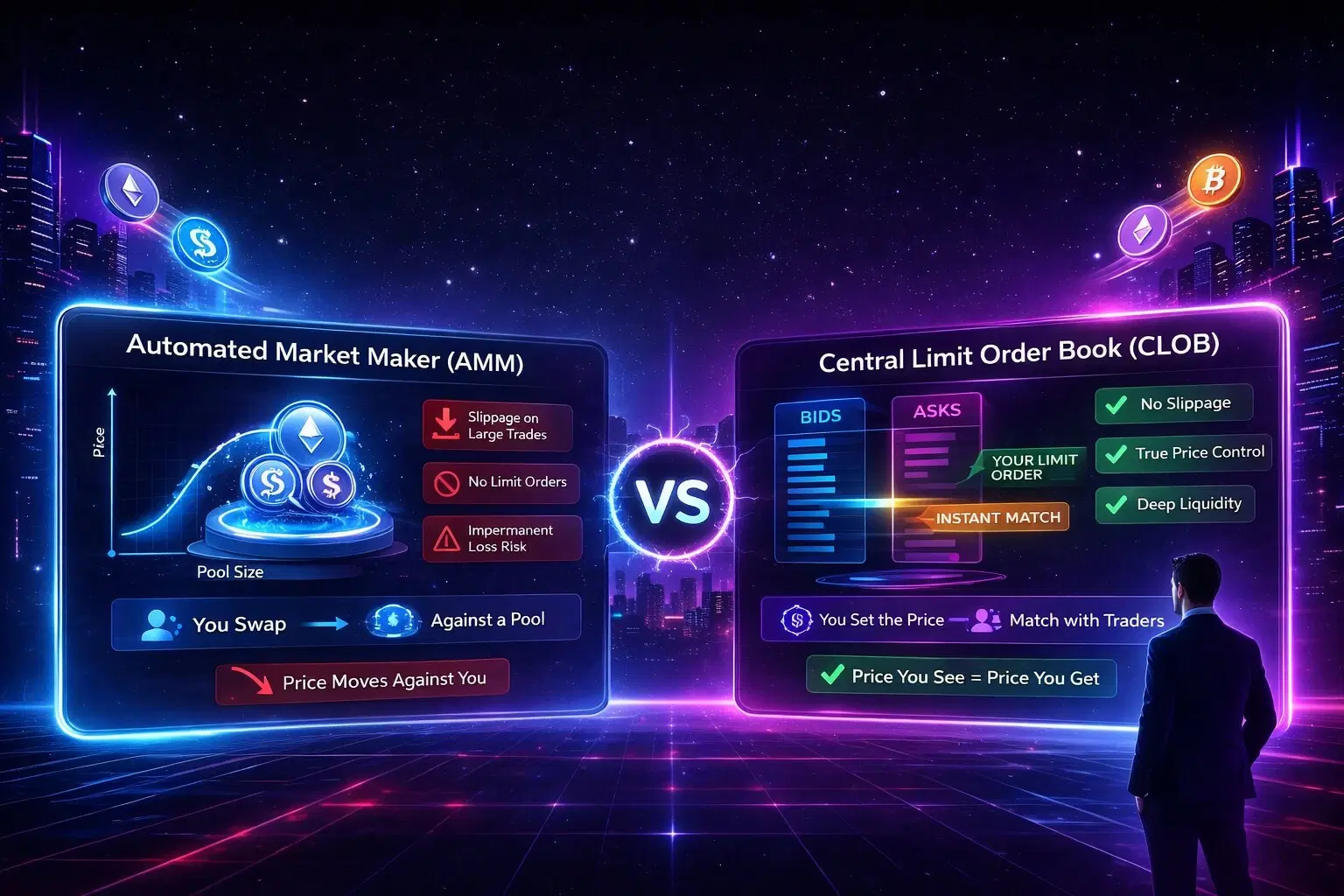
Explore the key differences between CLOB and AMM models in crypto trading. Discover the advantages of Dexalot's CLOB over AMMs for reduced slippage in decentralized finance.
Imagine you want to swap $80,000 of USDC into ETH on a major DEX. You check the quoted price — $3,200 per ETH — and hit confirm. By the time the transaction settles, you’ve received ETH worth $3,312 per unit on average. That $112 gap isn’t a fee, a bug, or bad luck. It’s the structural consequence of the mechanism powering most decentralized exchanges today: the Automated Market Maker (AMM). Multiply that across thousands of trades and you’re looking at effectively a “systemic tax” on every serious participant in DeFi.
There is a better model. The Central Limit Order Book (CLOB) — the same architecture that powers the NYSE, Binance, and every professional trading venue on earth — is available on-chain, and has been proven at scale.
This article explains exactly why the CLOB model is structurally superior to AMMs and how Dexalot delivers it without the tradeoffs that held earlier implementations back.
An Automated Market Maker doesn’t have a counterparty. Instead of matching you with another trader, it prices your trade using a formula. The most common is the constant product formula: x × y = k, where x and y are the quantities of the two tokens in a liquidity pool, and k is a constant that must be preserved after every trade.
Here’s what that means in practice. Say a pool holds 1,000 ETH and 3,200,000 USDC, giving k = 3,200,000,000. You want to buy 10 ETH. After your purchase, the pool will have 990 ETH. To keep k constant, the USDC balance must rise to 3,232,323 USDC — meaning you paid $32,323 for 10 ETH, or $3,232.30 per ETH instead of the headline price of $3,200. That difference is slippage, and it scales non-linearly. Buy 100 ETH from the same pool and the average price climbs to roughly $3,560. The formula punishes size.
The AMM doesn’t see your order coming. It reacts to it. That reactive pricing is the root cause of every slippage complaint in DeFi.

The constant product formula creates a second problem for the people funding these pools. Suppose you deposit liquidity when ETH is $2,000, contributing 1 ETH and $2,000 USDC (total value: $4,000). ETH then rises to $3,000. A rational arbitrageur immediately buys ETH from the pool until the AMM’s implied price matches the market. After rebalancing, the formula gives you approximately 0.816 ETH and 2,449 USDC — a total of $4,898. Had you simply held your original 1 ETH and $2,000 USDC, you’d have $5,000. The $102 difference is impermanent loss. It’s the price the AMM charges for using your capital to absorb arbitrage.
The word ‘impermanent’ is misleading. The loss only reverses if ETH returns exactly to $2,000. In any other scenario — ETH continues higher, drops, or stabilizes at a different price — you’ve permanently underperformed a simple hold. In volatile markets, this isn’t an edge case. It’s the baseline outcome for most liquidity providers.

A Central Limit Order Book collects all outstanding buy and sell orders in a single list, ranked by price and time. When a buyer’s price matches a seller’s, the trade executes. No formula. No pool. No reactive pricing.
The critical difference is agency. In an AMM, the formula sets your execution price after the fact — you find out what you paid when the transaction confirms. In a CLOB, you decide the price before anything happens. Say you want to buy 100 ETH and you’re willing to pay $3,250. You post a limit order at $3,250. It either fills at that price or it doesn’t execute at all. There is no formula moving against you mid-trade, no pool rebalancing at your expense. The $36,000 in extra cost from the AMM example above simply doesn’t exist in this model.
You also gain full market visibility. A real-time order book shows you every outstanding bid and ask, the depth at each price level, and exactly where supply meets demand. That’s not cosmetic, but it’s actionable information that changes how you size and time positions.
| Metric | AMM | CLOB |
| Price Discovery | Algorithmic — formula reacts to your trade after the fact | Market-driven — buyers and sellers agree on price in advance |
| Slippage | Guaranteed on large orders; grows with trade size | Near-zero — you set the price, it either fills or it doesn’t |
| Limit Orders | Not natively supported | Core functionality — set exact entry and exit prices |
| Liquidity Pool Risk | Impermanent loss erodes returns in volatile markets | No liquidity pools, no impermanent loss |
| Large Trade Execution | Price impact worsens exponentially with size | Deep order book absorbs large orders with minimal impact |
| Transparency | Pricing formula visible, but individual orders are not | Full order book visible in real time — complete market depth |
The reason AMMs dominated DeFi for years wasn’t ideological. It was technical. A proper order book requires thousands of state updates per second — every new order, cancel, and partial fill needs to be recorded and propagated immediately. On Ethereum mainnet, where every transaction competes for the same block space and gas costs spike under load, this was economically and technically unworkable.
The solution was purpose-built infrastructure: dedicated blockchains that process only trading activity, free from the congestion of general-purpose networks. Today, several CLOB exchanges, including perpetual futures DEXs like Hyperliquid, Aster, Lighter and spot DEXs like Dexalot, run on their own chains for exactly this reason. Sub-second finality and the throughput a real order book requires are now achievable on-chain. What separates these platforms is not whether they have a dedicated chain, but what they do with it.
Dexalot runs its CLOB engine on its own chain, but the defining distinction is what it preserves: true self-custody. Platforms like Hyperliquid require you to bridge assets onto their chain and leave them there — you’re trusting their infrastructure with your funds. On Dexalot, your assets remain under your control at all times. No custody hand-off, no KYC, full on-chain transparency.
The trading interface will be immediately familiar to anyone coming from a centralized exchange (CEX). Limit orders, market orders, and a live order book with real-time depth are all standard. There are no liquidity pools, which means there is no impermanent loss — for anyone. Liquidity providers on Dexalot are market makers and other traders posting orders, not passive depositors exposed to the constant product formula.
Dexalot is also a multichain DEX. While the CLOB engine lives on its own chain, traders can interact with it from Avalanche, Base, BNB Chain, Arbitrum, Ethereum and Monad — with more chains being added. You don’t need to migrate to a new ecosystem; you trade from the chain you’re already on, with your own wallet, holding your own keys.
Active traders who migrated from a CEX will find the interface immediately recognizable — limit orders, order book depth, real-time fills. It works the way a trading platform is supposed to work.
If you've taken losses on AMM slippage, the math earlier in this article explains exactly why it happened. A CLOB removes that cost structurally. It’s not a better AMM — it’s a different mechanism entirely.
For market makers, the environment Dexalot offers — a real order book, multichain reach, and dedicated L1 throughput — simply doesn’t exist at this level elsewhere in decentralized trading. You’re not competing with a formula. You’re posting prices into a real market.
The case for CLOB over AMM isn’t a matter of preference — it’s a matter of execution quality, capital efficiency, and giving traders the tools that professional markets have always required. Dexalot brings all of that on-chain, without asking you to give up custody or trust a central party.
Try it at app.dexalot.com .